The First Bite

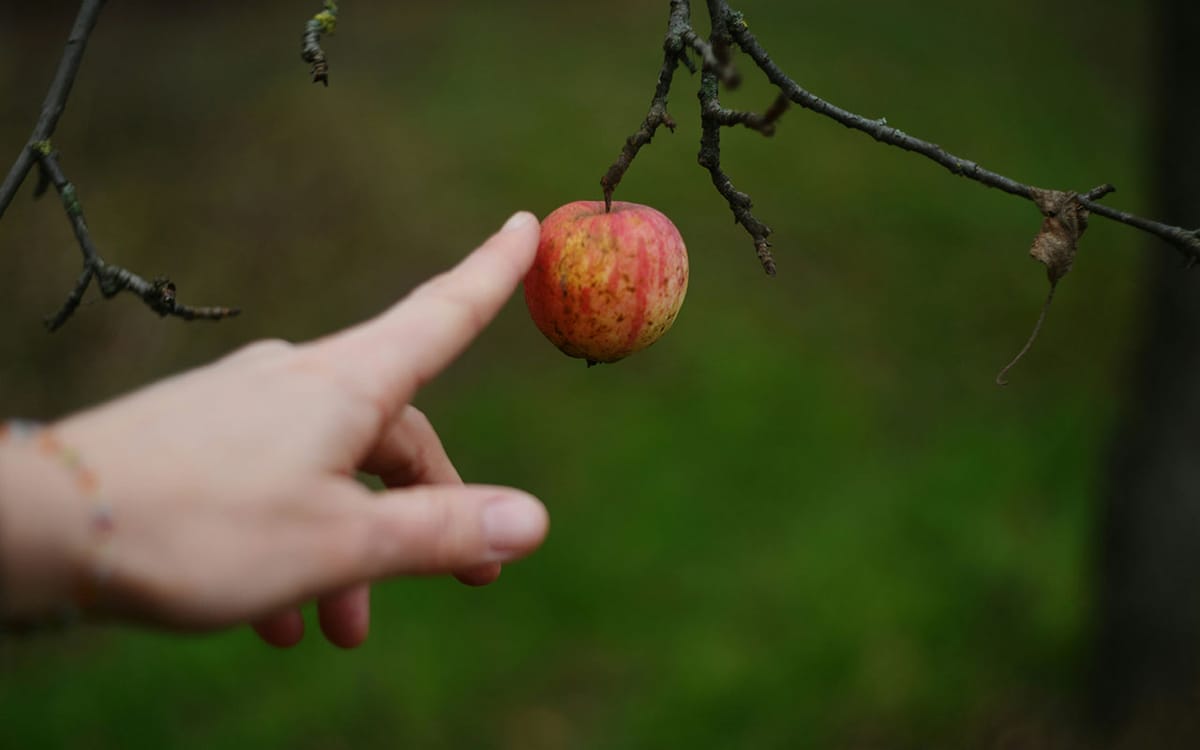
The story is often told as though it happened once, in a garden long ago. A single act of disobedience that fractured the world. Yet the deeper reading, the one contemplative traditions keep returning to, is that the bite never ceased. It unfolds now. When the mind draws a line between self and other, when knowing supplants wondering, when sufficiency quietly displaces belonging, the fruit is taken once more. The fall is not history. It is the present moment, misperceived.
The symbols shift across traditions and centuries. A garden, a veil, a forgetting, a departure from the Way. Beneath the imagery, the architecture remains. What appears as ambition, the desire to rise, to know, to become something greater, is not ambition at all. It is a turning away. And it begins with the quiet conviction that "I" exist apart from the whole.
The ancient Greeks gave this pattern a shape: the ouroboros, a serpent devouring its own tail. Self-consumption disguised as completion. The mind that seeks to know itself by separating from everything else eventually has nothing left to feed on but its own constructions. It circles endlessly, mistaking repetition for progress. The serpent in Eden and the serpent eating itself are not unrelated symbols. Both describe what happens when consciousness turns inward not with clarity but with appetite.
In Genesis, Adam and Eve dwell in completeness. Nothing is absent. One instruction remains: do not eat from the tree of the knowledge of good and evil. The danger lies not in the fruit itself, but in the perception it awakens, the capacity to divide reality into opposites. Self and other. Sacred and profane. Worthy and fallen. Before the hand closes around the fruit, something subtler has already occurred. The eye has found it. The mind has named it. The separation has already begun before the first bite.
The serpent offers not strength, but autonomy. You shall be as gods, knowing good and evil. And the moment they eat, they do not see more clearly. They see themselves. For the first time, they perceive their own separateness. What was whole becomes divided. What was open becomes guarded. Shame, craving, and fear arise together, not as punishment but as the natural consequence of severing self from source.
The exile from Eden is not wrath. It is geometry. Wholeness and the insistence on separateness cannot occupy the same ground. Paradise is not a place taken away. It is a state that dissolves the moment division takes root.
General relativity dissolved the notion of an independent observer standing outside space and time. There is no absolute frame. Every observation is relational, shaped by the position and context of the one observing. Quantum mechanics pressed further. At the subatomic level, phenomena do not possess definite properties until measured. Particles separated by vast distances behave as though they were never apart. The harder science looks for independent, self-existing things, the more it finds relationships. These are not spiritual claims. They are empirical observations. Yet they converge on the same insight that contemplative inquiry reached through an entirely different door.
Buddhism identifies the root of suffering as avijjā, not a lack of knowledge but a misapprehension of how experience unfolds. All phenomena are conditioned, arising and passing, empty of any permanent center. Yet the mind constructs a solid "me" behind each flicker of contact. From that single construction, sakkāya-diṭṭhi, the deeply held sense of a self standing apart, the rest cascades. Grasping, aversion, restlessness, pride, despair. The fruit in Eden and the first link in dependent origination illuminate the same event from different shores.
Islam names this fracture shirk, the splintering of what is inherently undivided. Hinduism calls it māyā, the appearance of multiplicity where the sacred never actually departed. Taoism expresses it most gently: the moment the living whole is carved into names, something essential has already vanished. Physics arrived at it most recently: there are no truly isolated systems. Different ages, different methods, one diagnosis. Separation is the original wound.
That wound did not close with the last verse of any scripture or the last line of any equation. It remains open now, perhaps wider than ever.
We are building a world that places the fruit within effortless reach. Systems that answer before the question fully forms. Tools that dissolve the need to consult, to depend, to sit openly with not knowing. The invitation is unchanged: you need no one else. The apple no longer hangs from a branch in some ancient orchard. It glows on your desk. It rests in your palm. It finishes your thoughts before you do.
And just as in the oldest telling, the moment you accept, you do not grow more whole. You grow more isolated. More capable, yet more adrift. The need for others was never frailty. It was the thread that kept each life woven into the fabric of all life. Sever it and you do not ascend. You float, untethered, in a freedom that slowly reveals itself as the deepest confinement. The ouroboros completes another circle.
The fracture does not confine itself to what we build. It is the same impulse behind every boundary we harden into identity. Race, nation, faith, class, ideology, gender, desire. Each is another turn toward the fruit. These distinctions arise within conditioned experience and carry real weight. But suffering takes hold the moment they crystallize from something observed into something owned, the moment "this is what I notice" becomes "this is what I am." Each identity, held tightly enough, becomes its own small exile.
The deepest realization available to a human being is not that they are extraordinary. It is that the separate self they have spent a lifetime protecting was never ultimately real. From within the architecture of ego this feels like annihilation. From beyond it, the recognition is the most luminous thing a mind can encounter. Not loss. Not surrender. Liberation, because what held the prison in place was only ever belief.
When that conviction loosens, what remains is not void. It is the undivided presence that was here before the story of "me" began. The garden before the fruit. Stillness before the naming. The wholeness that no tradition created and no experiment produced, yet that each, through its own lens, keeps confirming was never absent.
You were never cast out of the garden. You only came to believe that you were.