The Longest Story

You have been inside a story for as long as you can remember. Not one that was read to you or played on a screen, but one that assembled itself so seamlessly around your experience that you never thought to question whether it was a story at all. It has a central character. It moves through time. It contains struggle and resolution, friends and adversaries, moments of triumph and stretches of quiet despair. It feels so thoroughly real that the possibility it might be a construction, a pattern rather than a record, rarely surfaces long enough to be examined. And it has been running for so long that its beginning is no longer distinguishable from your own.
This is not an essay about what makes storytelling effective. It is an observation about why the structure of a story mirrors the structure of selfhood so precisely that the two may not be separate things at all.
No narrative can exist without a protagonist. Someone at the center around whom events arrange themselves. Without that anchor there is no story, only scattered occurrence. The mind operates identically. From the first moment of waking, experience organizes itself around a felt center, a "me" to whom things happen. Sensations arrive and are claimed. Thoughts arise and are authored. Memories surface and are owned. The central character does not need to be introduced. It is assumed before any scene begins. Heroes, role models, adventurers, villains, all the figures that cultures build their narratives around, function because the audience already knows what it feels like to be the main character of a life. The story does not create that sensation. It mirrors what consciousness is already doing.
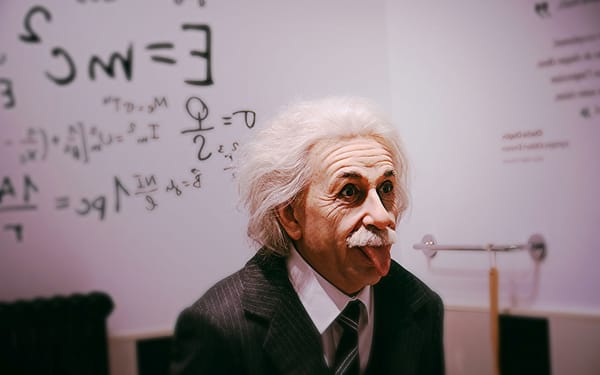
But a character standing still is not yet a story. What brings the narrative to life is time, a before and an after, a sequence in which events unfold and the audience leans forward wondering what comes next. Without progression there is no tension, no suspense, no arc. The sense of being a continuous self depends on this same scaffolding, the feeling that "I" was here a moment ago and will persist a moment from now. Einstein revealed that time is not the fixed stage it appears to be. It bends with mass and velocity. It is relative to the observer. Minkowski, his former professor, went further and dissolved the boundary between space and time entirely, describing reality as a single interwoven fabric. The stage the self performs on is as constructed as the performance. Yet the narrative keeps unfolding as though the theatre were solid.
Once there is a character moving through time, something must resist them. Opposition is what gives the arc its shape. Good against evil, known against unknown, desire against obstacle. Without duality there is no movement. The mind constructs experience along the same axis. Pleasant and unpleasant. Gain and loss. Self and not-self. These oppositions feel like discoveries about the world, but they are the mind's own divisions projected outward. You cannot feel like a separate individual without something to be separate from. The adversary is not an inconvenience to the central character. It is a structural requirement. Without contrast, the center cannot hold.
Then comes the promise that keeps everything in motion: resolution. A climax where fate is met, where the character prevails or falls, where meaning crystallizes out of chaos. This is the architecture's spine. The mind depends on the same promise. The sense that your life is leading somewhere, that experience accumulates toward something, that there will be a moment when it all coheres. Remove that expectation and the entire narrative wobbles. Not because life has lost purpose, but because the self that needed purpose to justify its existence has lost its scaffolding. And so the story circles back, finds a new conflict, sets a new destination, begins again. It has been doing this longer than this story began.
And running through all of it, binding character and time and opposition and resolution into felt reality, is emotion. The surge of recognition when a character speaks to something you have carried silently. The grief when loss on a screen mirrors loss in memory. The elation when triumph arrives as though it were your own. Emotion is not a reaction to the narrative. It is the adhesive that makes it feel lived rather than observed. Without it, sequence remains sequence. With it, sequence becomes experience. And experience, felt deeply enough, becomes identity.
Civilizations have preserved storytelling not as entertainment but as something closer to necessity. It is how culture transmits itself, how values are absorbed without instruction, how entire populations come to share a sense of what is real and what matters. But beneath that cultural function lies something more fundamental. Storytelling persists because it is the most faithful external mirror of what consciousness does internally. The mind does not merely use narrative. It is narrative. The sense of self is not the author of the tale. It is the tale's most convincing character.
And when that character is threatened, when the story of "me" is questioned or challenged, the mind does not pause to examine. It expands. It constructs new layers of identity and defends them with the same urgency it once reserved for physical survival. This is mine. These are my people. That is my country. This is my belief system. That is my gender. These are my rights. These are my values. The divisions multiply not because the world demands them but because the narrative demands them. A self under threat does not simplify. It proliferates. It draws new boundaries, names new adversaries, claims new territories. We do not stop at skin or culture. We extend ownership to the land beneath our feet, the system of planets we orbit within, the galaxy we were born into, as though the cosmos itself needed to be carved into mine and not mine. The same reflex that once separated self from other now separates species from species, world from world, star system from star system. The scale changes. The story is the same one it has always been, retold at a wider aperture.
The protagonist you have been defending, the timeline you have been tracking, the conflicts you have been navigating, the resolution you have been awaiting, these are not evidence that you exist as a separate, solid entity moving through a fixed world. They are the precise mechanisms by which that impression is sustained. The audience is on stage. The witness is part of the performance.
Perhaps the most honest question a person can sit with is not who am I but what is this story, and what would remain without it. Not as a philosophical exercise. Not as a problem to solve. But as a genuine willingness to look at the architecture that has been running, without pause, since before you learned your own name. There is a quiet exhaustion in carrying a narrative this long, in maintaining a character who must keep finding new reasons to exist. The recognition of that weight is not failure. It is the first honest breath the mind has taken in a very long time. And what it finds beneath the fatigue is not emptiness. It is the awareness that was here before the first scene was set, before the story learned to narrate its own beginning. Not void. Presence. The kind that does not need a story to know it is alive.