Why AI Challenges Us - Part 2: Ego, Pure Awareness, and the Illusion of Ascent

In Part One I reflected on how the emergence of artificial intelligence agitates the ego, unsettles our sense of certainty, and quietly exposes how fragile our assumptions about reality truly are. Here I move closer to the center. No machine, no matter how refined, can stand in for a mind itself as revealed through direct insight into the nature of awareness. This is not a sentimental claim. It is a structural truth about reality, cognition, and balance.
Discussions around artificial intelligence often fracture into opposing camps. We argue about superiority, human versus machine, without noticing that the deeper error lies in the habit of dividing at all. As technology accelerates some minds turn outward toward measurable progress while others turn inward seeking refuge amid instability. Science, mathematics, and engineering dominate the outer world. Wisdom is pushed to the margins, often burdened by old wounds where rigid beliefs once suppressed inquiry. Yet even the most disciplined rational mind senses it: something essential is missing when intelligence is reduced to computation alone.
The quiet tragedy of our time is the elevation of accumulated knowledge as the highest attainment. When intellect stands alone imbalance follows. Apparent advancement conceals stagnation. Profound wisdom must walk alongside knowledge or both deteriorate. The Middle Path is not an abstract ideal here. It is a functional necessity. Without it intelligence sharpens while discernment erodes.
Neural networks whether biological or artificial invite bold claims of emergent intelligence. On closer inspection we see only processes unfolding. Neurons organic or silicon-based are conditioned sequences performing momentary functions. What we call the brain is a vast coordination of such flows, not the origin of experience. The brain is form, an interface translating sensory contact into electrical signals. Awareness itself is another stream of processes. Knowing arises moment by moment at the point of contact without a fixed core or permanent substance. Awareness does not arise from matter. Matter appears within awareness as part of the same flowing interdependence.
All experience, color, sound, thought, feeling, identity, arises at the meeting point of contact and this momentary knowing. Feelings and perceptions are conditioned, dependently arisen, impermanent, unstable, and without inherent self. Machines can measure wavelengths and assign labels. They can simulate agreement and pattern recognition. They cannot participate in the lived knowing of red as it unfolds in awareness. They cannot feel meaning. The intimate sense of individuality that feels so personal flows through the same underlying processes in every being. Labels such as biological, digital, artificial, general, or superintelligent are linguistic conveniences, not indicators of essence.
Artificial intelligence remains by its nature a constructed instrument. It can assist, extend, and accelerate human capability but it cannot replace the living stream of awareness that knows directly. Whatever awareness brings forth can only be truly known and felt within that same stream of processes. These systems do not meet experience directly. They do not suffer, awaken, or reach cessation. Science, mathematics, and physics are powerful and precise within the measurable domain yet they remain bounded tools of the conditioned world. They cannot access the dimension of direct knowing that reveals itself only through penetrative insight.
This is where urgency becomes unavoidable.
When we observe nature through both scientific lenses and contemplative clarity we do not see a race for dominance. We see layered systems of balance and interdependence. Every organism occupies a place. Each supports the whole through mutual limitation and overlap, not conquest. The untrained mind projects a hierarchy of power, the lion crowned king of the jungle, but this is a cultural fiction reinforced by stories and selective perception. Careful observation, whether in field biology or through the lens of evolution, shows no single species rules in isolation. Restraint, domain-specific roles, and reciprocal dependence are what sustain thriving ecosystems.
Extend this pattern outward to planetary systems, star clusters, galaxies, and the distortion of chasing supremacy becomes even clearer. The drive to be on top arises from narrow seeing. It may appear strategically intelligent in the short term but it is neither wise nor sustainable over deep time.
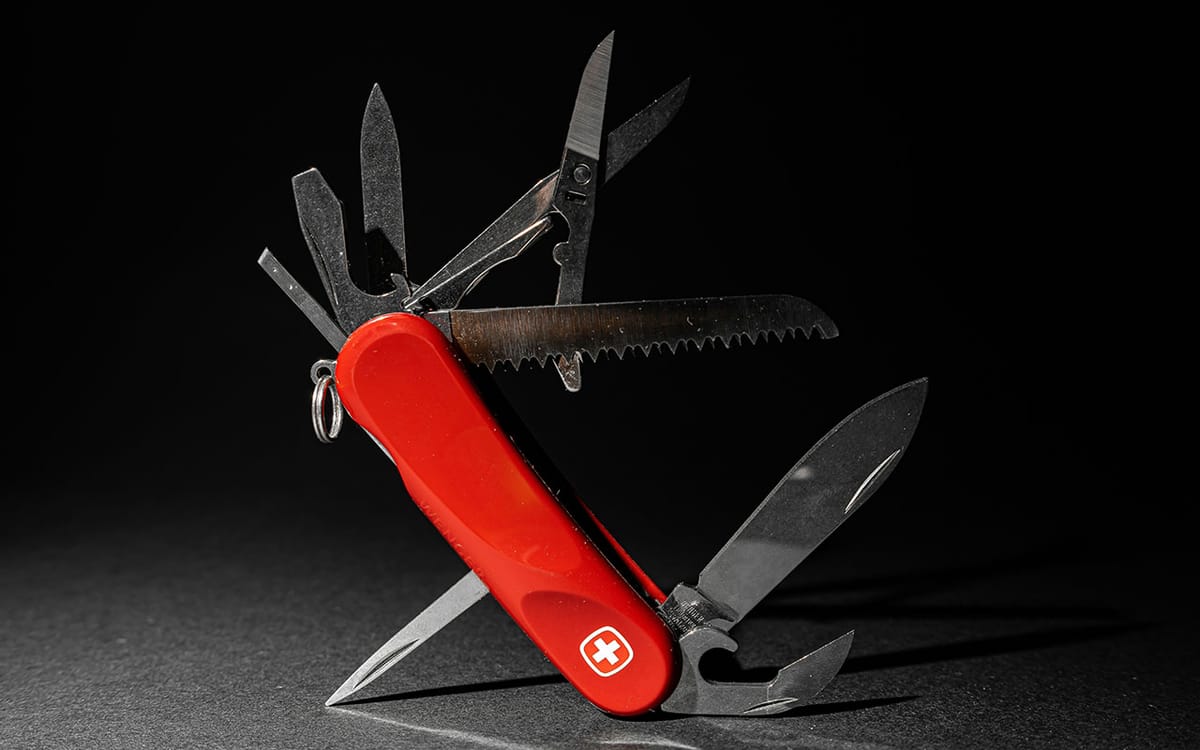
Artificial intelligence is extraordinarily helpful in properly bounded contexts and profoundly dangerous when those boundaries dissolve. Correct application is not optional. It is essential. A Swiss Army knife serves beautifully when camping, yet it is too constrained and inadequate as a whole to handle anything beyond narrow, predefined tasks. This is not poetic caution about great power and great responsibility. It is structural risk. Entrusting vast capability to an ideology still gripped by imbalance is closer to handing a chimpanzee nuclear launch codes and hoping instinct evolves into wisdom overnight.
We are capable of this shift. But if we refuse to make it deliberately and collectively the decision will be made for us, and it will not be gentle.
That moment is no longer approaching.
It is already here.